

Effective waste management is a key part of any well-run commercial or strata building in the Sutherland Shire. From bin collection and skip hire to long-term operational waste planning, getting it right improves safety, keeps common areas clean, and ensures your building stays compliant with local council and EPA guidelines.
In this guide, we’ll cover what a waste management plan should include, how to design functional bin storage areas, and practical ways to future-proof your building’s waste setup, whether it’s a new development or an existing site.
1. Operational Waste Management Plan
A waste management plan isn’t just a box to tick during the development application process. It’s a working document that should be reviewed and updated regularly to support the ongoing safety, compliance, and day-to-day function of strata and commercial buildings.
What goes into a waste management plan?
- Waste generation, including type and volume
- Reuse and recycling potential
- Waste systems, such as provision for waste separation and details of any garbage chute or compactors
- Bin quantity, size and type/colour
- Proposed bin storage and collection areas, including how bins are to be moved from waste storage area/s to collection area/s and to the truck for collection
- Collection frequency
- Collection location, i.e. onsite, temporary bin holding area or kerbside).
- Scaled waste management drawings
- Waste vehicle access (swept path analysis)
- Detail of the ongoing management, maintenance and cleaning of all waste and recycling management facilities
Source: Sutherland Shire Council
2. Waste Storage Area
A dedicated waste storage area is essential and should be easily accessible from the street for collection. It must include enough bins for general waste and recycling to prevent overflow and illegal dumping.
The storage area should be:
- Located in a position that is convenient for residents, tenants and collection services
- Situated behind the building line
- Maintain the amenity of the development and the character of the streetscape
- Constructed in accordance with the requirements of Building Code of Australia
- Designed to allow easy access and bin manoeuvring, with enough space to support regular cleaning and maintenance
- Constructed in accordance with the requirements of the Building Code of Australia
- Provided with a separate ventilation system to comply with AS 1668 – The use of mechanical ventilation and air-conditioning in buildings
Source: Sutherland Shire Council & NSW EPA
For mixed-use developments, separate waste storage areas should be provided for residential and commercial use. In larger developments, multiple waste areas may be needed to manage volume and access effectively.
Bulky household items like furniture should be stored in a separate room or secure caged area until collection.
Services such as electrical meter boards or gas meters should not be installed in the waste storage area, as they may be damaged during bin collection or cleaning.
Future Planning
Planning space for waste storage is challenging because future collection needs can be hard to predict.
To allow for flexibility, it’s important to consult with waste contractors early and design storage areas with extra space, clear access, and adaptable layouts that can accommodate changes in bin size or service types over time.
3. Health and Safety
Waste collection methods and systems in commercial buildings must comply with the Work Health and Safety Act 2011 and relevant regulations.
The NSW WorkCover Code of Practice for the Collection of Domestic Waste can also provide useful guidance when designing waste facilities for commercial settings.
Waste management should be designed in a way that minimises any risk to tenants, building management and staff that access the building.
Source: NSW EPA
Control measures include:
- Make sure there is enough space to move bins easily from storage areas to the collection point
- Ensure the path between storage and collection areas is level and free of steps or steep slopes
- Choose collection points that are easy for vehicles to access, with enough space, height clearance, strong surfaces and safe driveway design
- Provide enough turning space for collection vehicles and keep these areas clear of obstacles that may block driver visibility
- Keep waste and recycling fully contained in the correct bins. Avoid loose rubbish in storage areas
- Use the right type and size of bins for each waste stream. Only use bins and equipment for their intended purpose
- Replace or repair any bins that are damaged or missing parts. Remove any unsafe or faulty equipment from public areas
- Do not lift mobile or wheelie bins by hand. These bins are designed for mechanical lifting
- If smaller bins are emptied into larger ones, make sure proper lifting equipment is installed and used
- Store bins and waste equipment securely and safely when not in use
- Provide personal protective equipment (PPE) such as gloves for anyone handling waste or bins, and ensure it is worn at all times
- Have education programs in place to teach staff or residents how to safely and correctly dispose of waste
- Avoid carrying bags of waste by hand over long distances. Use bags only to line bins. Once removed, place them directly into a wheeled bin or other safe container
Source and more information on waste control measures at: NSW EPA
4. Garbage Bins and Waste Equipment
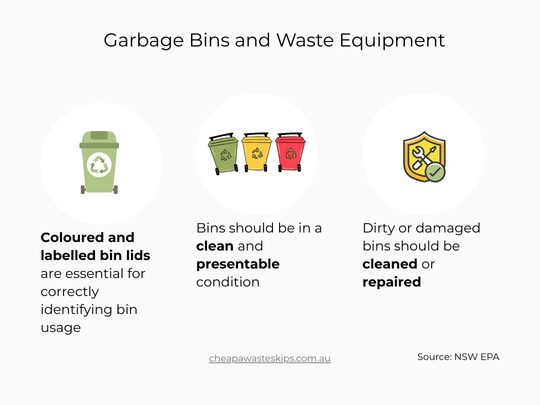
All garbage in strata or commercial buildings need to be in bins or containers with well-fitting lids and should conform to AS 4123 Mobile Waste Containers.
Further recommendations from NSW EPA:
- Coloured and labelled bin lids are essential for correctly identifying bin usage
- Bins should be in a clean and presentable condition
- Dirty or damaged bins should be cleaned or repaired
5. Bin Collection Points
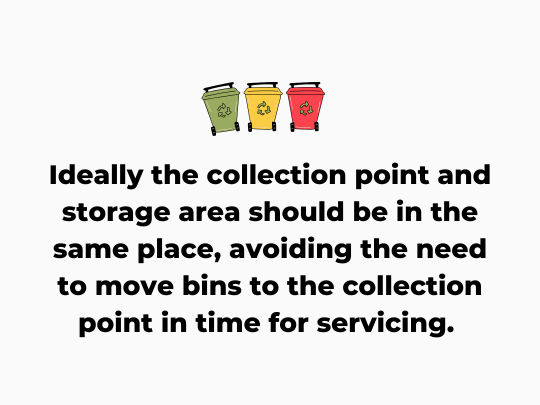
Ideally, bin collection points should be easy for contractors to access and located close to the storage area to minimise the distance bins need to be moved.
Collection points should:
- Not be located near pedestrian crossings, ramps, roundabouts, busy roads, or narrow lanes
- Not be located near overhead wires, trees, or other obstructions
- Be on level surfaces suitable for heavy vehicles
- Have sufficient space for garbage trucks to collect waste and safely turn, or exit the site as needed
- Be away from public areas
- Not be restricted by parked cars, vehicle loading or unloading, street furniture or signs
- Not require vehicles to reverse
- Be accessible at times the collections are scheduled to take place
Source: NSW EPA
6. Skip Hire In The Sutherland Shire
Strata and commercial buildings often need one-off waste collections to manage overflow or clear out bulky items. That’s where skip bin hire makes sense. With a flexible provider like Cheapa Waste Skips, you can choose from a range of skip sizes, including options for recyclables.
You simply pay per skip, with no extra costs, making it easy to manage costs as your building’s requirements evolve.
For one-off waste needs, skip bin hire is a practical solution, ideal for office cleanouts, renovations, or events that generate extra rubbish.
Contact Cheapa Waste for skip bin hire in the Sutherland Shire and South Sydney areas.
Call Adam on: 0414 308 936.